

Pleniko Blog
Real Estate Sales Platform: Private Company Portal or Multi-Vendor Marketplace?
- Real Estate Platform
- Property Marketplace
- Multi-Vendor Real Estate
- Real Estate Agency Website
- Property Listing System
- Real Estate Software
- Property Search
- Listing Management
- Real Estate Digitalisation
- Property Portal
- Real Estate Technology
- PropTech
 AuthorPlamen Nikolov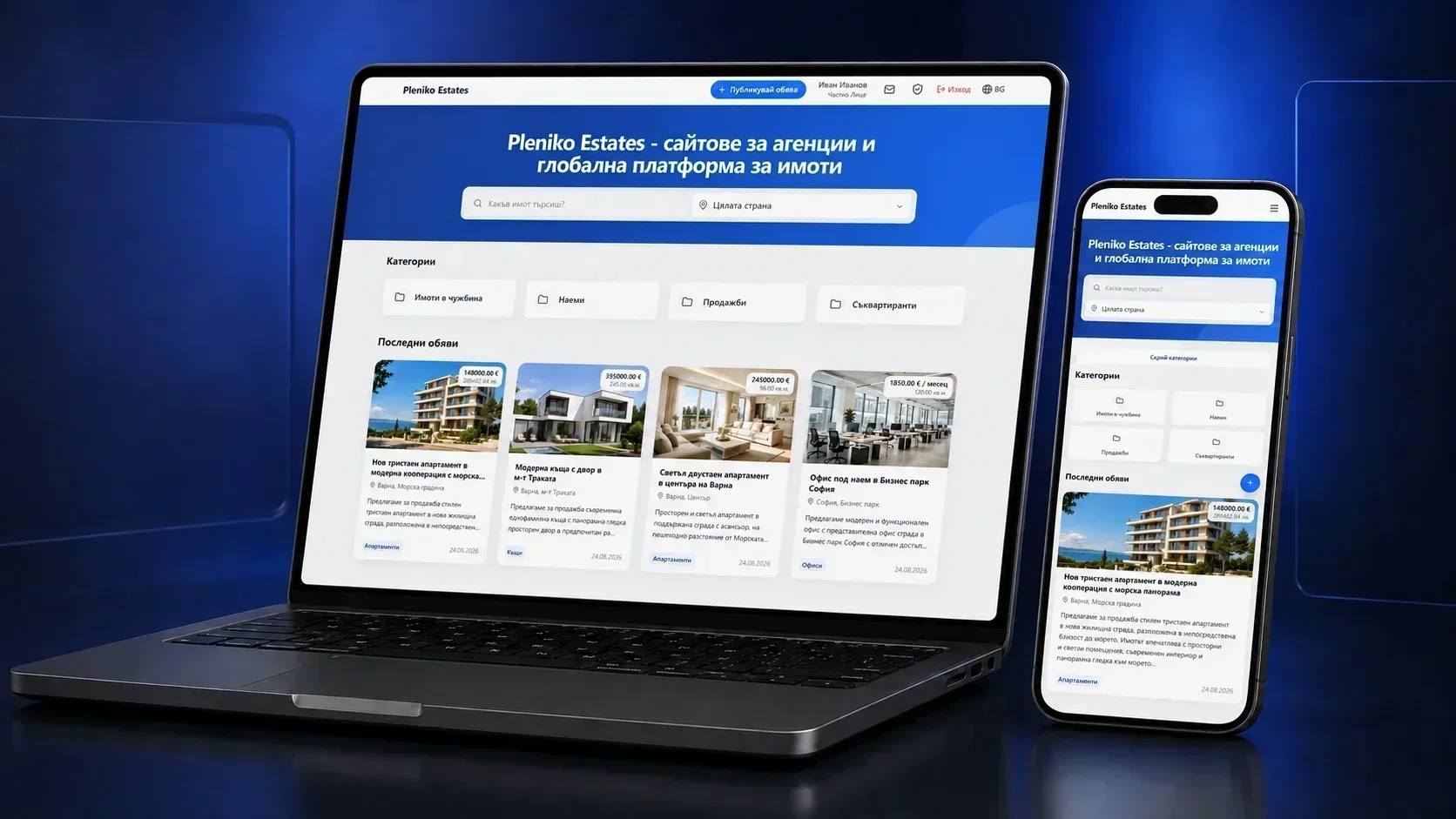
Property sales and rentals increasingly begin online. Before contacting an agent, agency or owner, users browse listings, compare prices, research locations and search according to specific criteria.
A modern real estate sales platform should therefore be more than a catalogue of photographs. It should simplify property discovery and presentation, organise enquiries and provide practical tools for administrators, agencies and agents.
Pleniko has already developed a system that can be delivered as a private real estate business website or as a multi-vendor property marketplace for agencies, agents, developers and private sellers.
Its design, content, user roles and business rules can be adapted to the objectives of the individual project.
One system for two different business models
The same technical foundation can be used in two primary ways.
It can operate as a company website displaying the portfolio of one agency, investor or property developer.
Alternatively, it can become an online marketplace where independent agencies, agents, developers and private sellers manage their own profiles and listings.
This allows the platform to support both the digitalisation of an existing property business and the creation of an independent real estate product.
A private website for an agency, investor or developer
A modern real estate sales platform should therefore be more than a catalogue of photographs. It should simplify property discovery and presentation, organise enquiries and provide practical tools for administrators, agencies and agents.
Pleniko has already developed a system that can be delivered as a private real estate business website or as a multi-vendor property marketplace for agencies, agents, developers and private sellers.
Its design, content, user roles and business rules can be adapted to the objectives of the individual project.
One system for two different business models
The same technical foundation can be used in two primary ways.
It can operate as a company website displaying the portfolio of one agency, investor or property developer.
Alternatively, it can become an online marketplace where independent agencies, agents, developers and private sellers manage their own profiles and listings.
This allows the platform to support both the digitalisation of an existing property business and the creation of an independent real estate product.
A private website for an agency, investor or developer

When the platform serves one organisation, all public pages, listings and enquiries are dedicated to that business.
The design can follow its visual identity, while the structure reflects the property types, services and locations in which the company operates.
Visitors do not see competing offers. They browse the company’s portfolio, learn about its services and contact its team directly.
This model is suitable for:
- estate agencies;
- construction and investment companies;
- new-build property developers;
- businesses managing their own property portfolios;
- independent agents with an established brand;
- companies offering property sales and rentals.
A multi-vendor real estate marketplace

Under the multi-vendor model, the platform serves many participants. Each approved agency, agent, developer or private seller can have a separate profile and manage its own listings.
The central administrator controls the overall settings, categories, users, content and publication rules.
The system can therefore operate as:
- a regional property portal;
- a national listing platform;
- a marketplace specialising in new developments;
- a platform for holiday or investment properties;
- a portal for property sales and rentals;
- a niche system for a specific property type or audience.
Account separation allows every participant to work only with its own listings and information. Visitors use a shared search experience and can compare offers from different vendors.
A public experience designed for buyers

The public website is where users discover and compare properties.
The home page can present selected offers, recent listings, popular locations, property categories and a quick search form.
Each property can have a detailed page containing:
- a photograph gallery;
- price and essential characteristics;
- a detailed description;
- location and map;
- floor area and layout information;
- building characteristics;
- furnishing information;
- video or virtual tour;
- agency or seller details;
- an enquiry form;
- an option to request a viewing.
A well-structured property page helps visitors quickly decide whether the offer matches their requirements.
Detailed property search and filters
When a platform contains many listings, an effective search engine becomes one of its most important features.
Users can filter properties by:
- sale or rental;
- property type;
- country, city, district and neighbourhood;
- minimum and maximum price;
- minimum and maximum floor area;
- number of rooms and bedrooms;
- storey;
- construction type;
- year of construction;
- condition and furnishing;
- parking space or garage;
- garden, terrace, lift and other characteristics.
The filters can be adapted to the platform’s particular focus. A new-build property system has different requirements from a portal for agricultural land, holiday properties or long-term rentals.
Profiles for agencies, agents and sellers
In a multi-vendor configuration, each participant can have a public page with a logo, description, contact details, team and active listings.
This helps visitors understand who is responsible for a particular offer and supports trust.
Depending on the platform’s rules, registrations may:
- be open to all users;
- require administrator approval;
- be available only after a contract is signed;
- be created manually by the administration team.
Separate roles and permissions can be assigned to account owners, employees, agents, editors and moderators.
Listing management through a secure dashboard
The administration area supports creating, editing, publishing, hiding and archiving properties.
Structured forms collect consistent information so that listings can be searched and filtered accurately.
Depending on the workflow, the system can use statuses such as:
- draft;
- pending approval;
- active;
- reserved;
- sold;
- rented;
- temporarily hidden;
- archived.
This helps the team keep information current and prevents unavailable properties from remaining visible as active offers.
Moderation and content quality
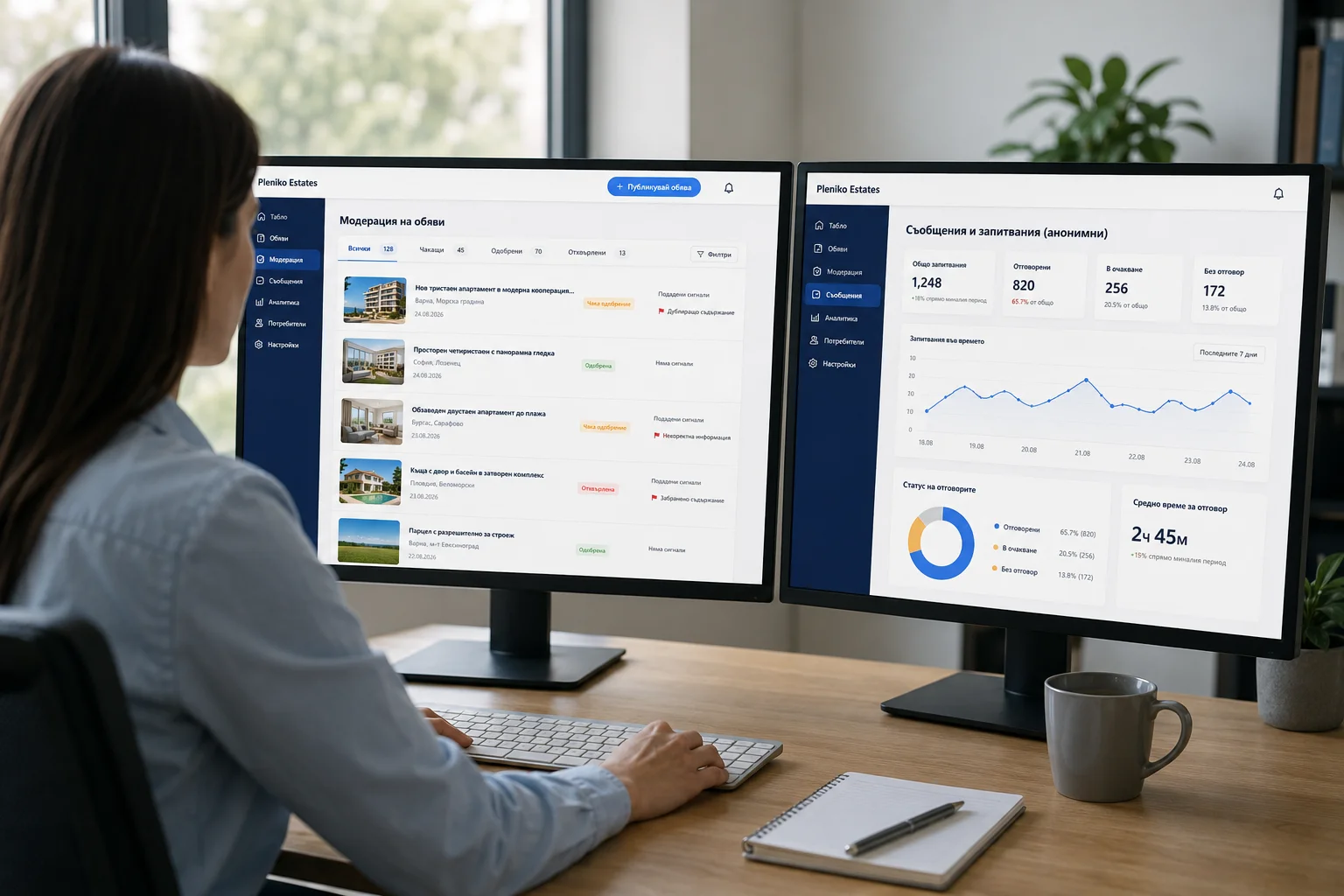
Listing quality is especially important in a marketplace with multiple sellers.
Publication rules can require specific fields, a minimum number of photographs, approved file formats and review before publication.
Administrators can:
- review new listings;
- approve or reject publication;
- return content for correction;
- correct incorrectly entered information;
- hide outdated offers;
- remove content that violates the platform’s rules.
Visitors may also be allowed to report inaccurate, misleading or outdated listings.
This helps the platform maintain a cleaner catalogue and a higher level of trust.
Enquiries and prospective customer communication
Every property enquiry should reach the correct person.
On a private company website, it may be assigned to a particular agent or the company’s shared team.
In a multi-vendor marketplace, the enquiry is connected to the agency or seller responsible for the listing.
The system can send notifications, retain history and help track interest in individual properties.
Additional capabilities may include:
- automatic enquiry assignment;
- email notifications;
- internal notes;
- follow-up tasks;
- communication history;
- CRM integration;
- enquiry statistics.
The platform therefore becomes a practical working tool rather than only a public catalogue.
Google visibility and technical SEO
Public property pages can be structured so that search engines can access and understand them.
Every listing has its own URL, title, description and images. Categories and locations can support landing pages such as:
- apartments for sale in Varna;
- houses near Varna;
- new developments in Sofia;
- offices for rent;
- land for sale;
- holiday properties by the sea.
The technical SEO foundation can also include appropriate metadata, sitemaps, canonical URLs, internal links, optimised images and fast loading.
When filters can create many URL combinations, the platform must carefully determine which combinations provide search value. Otherwise, it may generate thousands of nearly identical pages.
Technical implementation alone cannot guarantee high rankings, but it provides the required foundation for useful local and subject-specific content.
Convenient use on mobile devices

Many users search for properties directly from a phone. Public pages, filters, galleries, maps and contact forms must remain easy to use across different screen sizes.
The administration area can also support mobile use when an agent needs to update information, change a status or review an enquiry away from the office.
Images can be optimised so that pages load quickly without losing the required visual quality.
Revenue options for a multi-vendor platform
If the system operates as an independent marketplace, it can support several revenue models.
Possible options include:
- monthly or annual subscriptions;
- limits on active listings;
- separate plans for agencies and private sellers;
- paid listing placement;
- promoted profiles;
- additional advertising positions;
- individual plans for large agencies;
- charges for selected additional services.
The marketplace can also begin as a completely free service and introduce commercial plans later.
Roles, limits and architecture should be planned so that future development does not require rebuilding the platform.
An existing foundation with individual adaptation
The project does not need to begin from an empty screen. The platform’s essential modules are already developed and can be configured around the required workflow.
The following elements can be adapted:
- visual identity and design;
- property types and characteristics;
- categories and locations;
- user roles and permissions;
- publication and approval workflows;
- languages and currencies;
- subscription plans and limits;
- external integrations;
- project-specific capabilities.
This approach combines a faster start with the ability to develop an individual product without restricting the business to a general-purpose template.
Which version is suitable for your business?
A private company website is appropriate when one organisation wants to present its portfolio, receive direct enquiries and manage its own team.
A multi-vendor marketplace is more suitable when the objective is to connect many agencies, agents, developers and private sellers within a shared online market.
In either case, the platform can be adapted to the actual business model instead of forcing the business to change its processes around software limitations.
Pleniko can provide the system as the foundation for a private real estate website or a separate multi-vendor product. Once the required roles, content, workflows and integrations have been defined, the platform can be configured and extended for the individual project.