

Pleniko Blog
Real Estate CRM & AI: From Listing to Deal
- Real Estate
- Real Estate CRM
- CRM
- Artificial Intelligence
- AI
- PropTech
- Property Management
- Real Estate Software
- Agency Software
- Lead Management
- Client Communication
- Business Automation
- AI Assistant
- Property Lifecycle
- Business Software
- Software Development
 AuthorPlamen Nikolov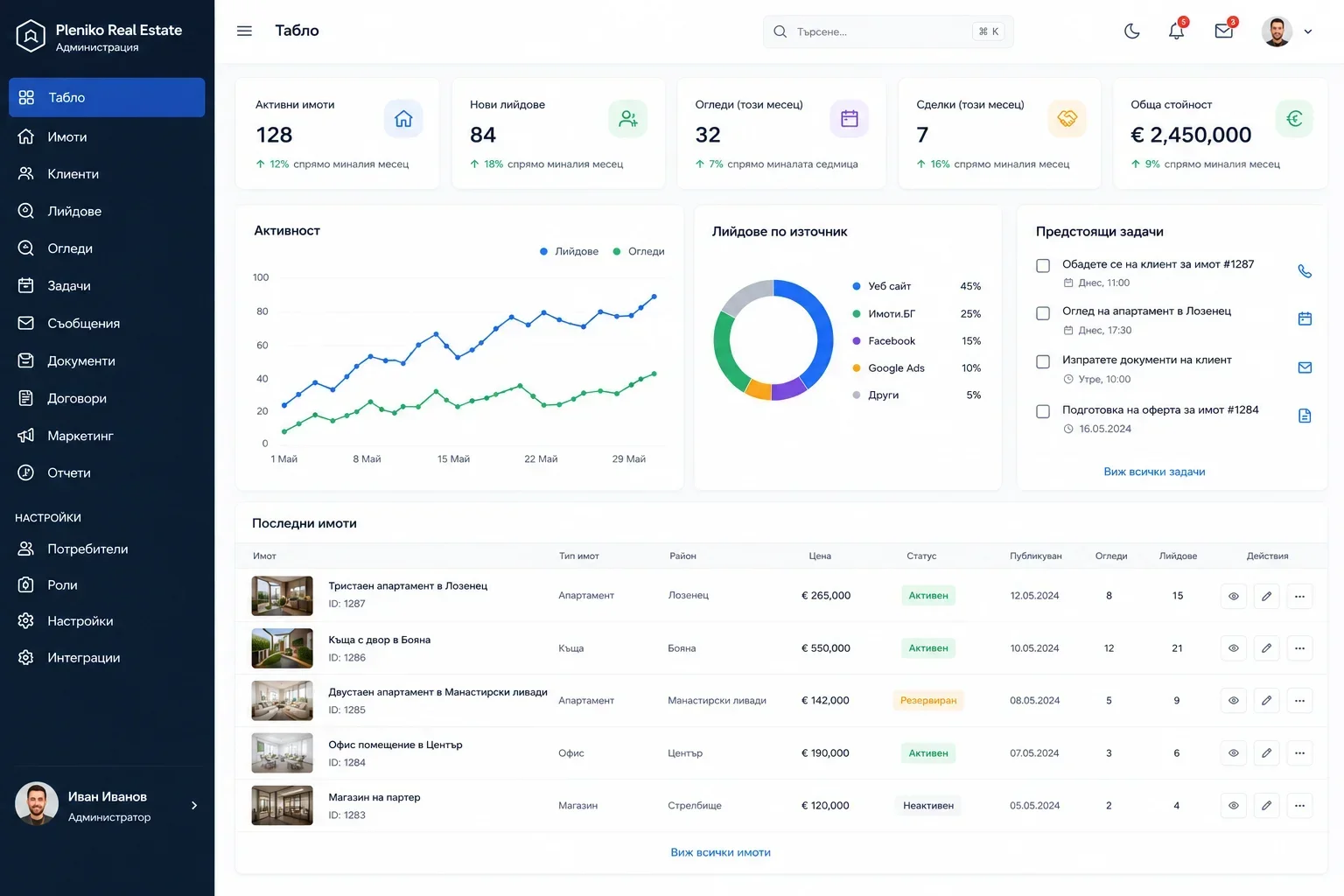
Why a Real Estate Website Should Be Directly Connected to CRM, AI and the Entire Sales Process
A real estate agency website should no longer be just a catalogue of photos, prices and phone numbers. When the public website, CRM system, client communication and internal workflows operate separately, data gets duplicated, enquiries are left without proper follow-up, communication history is lost, and management has little visibility into what is actually happening with a specific property.
A better approach is to make the public website part of a unified real estate management platform. In this model, a property is not just a listing. It becomes the central object connecting the owner, agent, buyers or tenants, leads, viewings, documents, tasks, communication and the full history of the sales process.
One property — one source of truth
One of the most common problems with separate websites and CRM systems is duplicate data entry. A property is entered into one system, copied into the website and then updated manually in several places whenever the price, status or description changes.
In an integrated platform, the property is created once, and its data is reused everywhere. The public website displays only customer-facing information, while the internal CRM stores additional data such as owner details, agreements, internal notes, responsible agent, price history, documents, calls, viewings, tasks and potential buyers.
The CRM must understand the property itself
Traditional CRM systems usually focus on the client or the deal. In real estate, that is not enough. The property itself should be one of the system’s central entities.
Owners, agents, buyers, enquiries, phone calls, emails, messages, viewings, tasks, offers, documents, contracts, price changes and status history can all be linked directly to the same property record.
Every lead should be linked to a specific property
A simple “Send enquiry” form is not enough. If a visitor contacts the agency from a particular apartment page, the system already has valuable context: which property was viewed, when the enquiry was sent, where the user came from and which agent should receive the lead.
Instead of merely notifying an agent that there is a new enquiry, the CRM can automatically create a structured flow: client → interest → property → responsible agent → communication → next task → result.
This makes it possible to track meaningful performance for each property, for example: 27 enquiries, 14 qualified clients, 8 viewings, 3 offers and 1 completed deal.
Communication should not remain outside the system
A large part of an agent’s work happens through phone calls, email, messaging apps and personal conversations. The problem arises when the outcome of that communication stays only on a phone or in the memory of one person.
A good CRM integration should keep a clear history: contact → conversation → interest → viewing → feedback → next step. This makes handovers easier and gives management a clear view of whether there is real activity around a property.
AI as an assistant, not a replacement for the agent
Artificial intelligence is most useful when it works with structured CRM data. It should not independently make critical business decisions. Its role is to become an assistant to the agent and the manager.
AI can analyse activity around a property and highlight situations such as: “The property has been listed for 34 days. It received 18 enquiries and 6 viewings, but no offer.” It can also summarise customer feedback and identify recurring objections, such as price or renovation needs.
An AI assistant for the property lifecycle
A practical feature is a dedicated AI assistant for each property. It can monitor the full lifecycle: New → Preparation → Published → Active → Viewings → Negotiation → Reserved → Sold/Rented.
The assistant can detect issues that deserve attention: no new enquiries for several days, many visits but a low contact rate, viewings without follow-up, highly interested clients without recent communication, or overdue tasks.
AI can reduce administrative work
Based on structured property characteristics, AI can suggest listing descriptions, SEO text, social media copy, summaries and translations. It can also summarise long communication histories and extract the most important client preferences.
Automatic matching between clients and properties
When the CRM and property catalogue use the same structured data, the platform can automatically match clients with properties. Criteria can include location, budget, area, number of rooms, floor, construction type, parking, condition and many other attributes.
When a new property is added, the system can find existing clients whose criteria match it. When a new client is added, the agent can immediately see suitable active listings.
A real estate agency website should no longer be just a catalogue of photos, prices and phone numbers. When the public website, CRM system, client communication and internal workflows operate separately, data gets duplicated, enquiries are left without proper follow-up, communication history is lost, and management has little visibility into what is actually happening with a specific property.
A better approach is to make the public website part of a unified real estate management platform. In this model, a property is not just a listing. It becomes the central object connecting the owner, agent, buyers or tenants, leads, viewings, documents, tasks, communication and the full history of the sales process.
One property — one source of truth
One of the most common problems with separate websites and CRM systems is duplicate data entry. A property is entered into one system, copied into the website and then updated manually in several places whenever the price, status or description changes.
In an integrated platform, the property is created once, and its data is reused everywhere. The public website displays only customer-facing information, while the internal CRM stores additional data such as owner details, agreements, internal notes, responsible agent, price history, documents, calls, viewings, tasks and potential buyers.
The CRM must understand the property itself
Traditional CRM systems usually focus on the client or the deal. In real estate, that is not enough. The property itself should be one of the system’s central entities.
Owners, agents, buyers, enquiries, phone calls, emails, messages, viewings, tasks, offers, documents, contracts, price changes and status history can all be linked directly to the same property record.
Every lead should be linked to a specific property
A simple “Send enquiry” form is not enough. If a visitor contacts the agency from a particular apartment page, the system already has valuable context: which property was viewed, when the enquiry was sent, where the user came from and which agent should receive the lead.
Instead of merely notifying an agent that there is a new enquiry, the CRM can automatically create a structured flow: client → interest → property → responsible agent → communication → next task → result.
This makes it possible to track meaningful performance for each property, for example: 27 enquiries, 14 qualified clients, 8 viewings, 3 offers and 1 completed deal.
Communication should not remain outside the system
A large part of an agent’s work happens through phone calls, email, messaging apps and personal conversations. The problem arises when the outcome of that communication stays only on a phone or in the memory of one person.
A good CRM integration should keep a clear history: contact → conversation → interest → viewing → feedback → next step. This makes handovers easier and gives management a clear view of whether there is real activity around a property.
AI as an assistant, not a replacement for the agent
Artificial intelligence is most useful when it works with structured CRM data. It should not independently make critical business decisions. Its role is to become an assistant to the agent and the manager.
AI can analyse activity around a property and highlight situations such as: “The property has been listed for 34 days. It received 18 enquiries and 6 viewings, but no offer.” It can also summarise customer feedback and identify recurring objections, such as price or renovation needs.
An AI assistant for the property lifecycle
A practical feature is a dedicated AI assistant for each property. It can monitor the full lifecycle: New → Preparation → Published → Active → Viewings → Negotiation → Reserved → Sold/Rented.
The assistant can detect issues that deserve attention: no new enquiries for several days, many visits but a low contact rate, viewings without follow-up, highly interested clients without recent communication, or overdue tasks.
AI can reduce administrative work
Based on structured property characteristics, AI can suggest listing descriptions, SEO text, social media copy, summaries and translations. It can also summarise long communication histories and extract the most important client preferences.
Automatic matching between clients and properties
When the CRM and property catalogue use the same structured data, the platform can automatically match clients with properties. Criteria can include location, budget, area, number of rooms, floor, construction type, parking, condition and many other attributes.
When a new property is added, the system can find existing clients whose criteria match it. When a new client is added, the agent can immediately see suitable active listings.
One screen should show the real status of the property
A good system should not force the agent to jump through dozens of menus. Opening a property should reveal its status, responsible agent, days on market, enquiries, active clients, viewings, offers, last contact, next task, documents and any AI-generated signal that requires attention.
Connections to public registers and external data sources
The next logical step is integration with external information sources — cadastral data, property registers, company registers, maps, geospatial services and other official or licensed sources.
The goal is not simply to collect more data. The important part is to connect that information to the specific property where the agent is already working. A cadastral identifier, related records, documents, and internal notes can all become part of the same digital property file.
Important: integrations with public registers must be implemented according to the technical, legal and licensing terms of each source. Not every public portal provides an open API or permits automated extraction and commercial reuse of its data.
Documents are part of the CRM workflow
Each property gradually accumulates contracts, declarations, cadastral documents, reports, floor plans and other files. Instead of spreading these across local folders, emails and cloud drives, they can be organised around the property itself.
The platform can track which document belongs to which property, who uploaded it, when it was added, its type and which version is current. AI can assist with classification and information extraction, while critical decisions and sensitive data remain under human control.
Management gets a real operational picture
When the website and CRM work together, management can use real metrics: which properties attract attention, which remain inactive for too long, how quickly leads are handled, how many viewings turn into offers, and where potential clients drop out of the funnel.
From a property website to the agency’s operating system
The public website is only one part of the platform. Behind it should work Property Management + CRM + Leads + Communication + Tasks + Documents + Analytics + AI + Integrations.
When all these components use the same data, adding a property no longer means merely publishing another page. It creates a digital property file that follows the complete lifecycle — from the first owner contact to the final deal.
Technology should reduce administrative work
A well-designed system should not become another application that agents are forced to maintain. Data is entered once, enquiries are automatically connected to the right property, communication stays traceable, tasks remain visible, documents are organised, clients are matched with suitable listings, and AI draws attention to what requires a human decision.
At that point, the CRM stops being just an administrative panel, and the website stops being just a catalogue. Together they become one system that follows the complete journey of the property, the client and the deal.