

Pleniko Blog
How to Share Properly on Facebook in 2026 – Reach, Spam Signals and Original Content
- Meta
- Social Media
- Facebook Algorithm
- Facebook Reach
- Spam Prevention
- Repetitive Content
- Original Content
- Social Media Marketing
- Digital Marketing
- Content Strategy
 AuthorPlamen Nikolov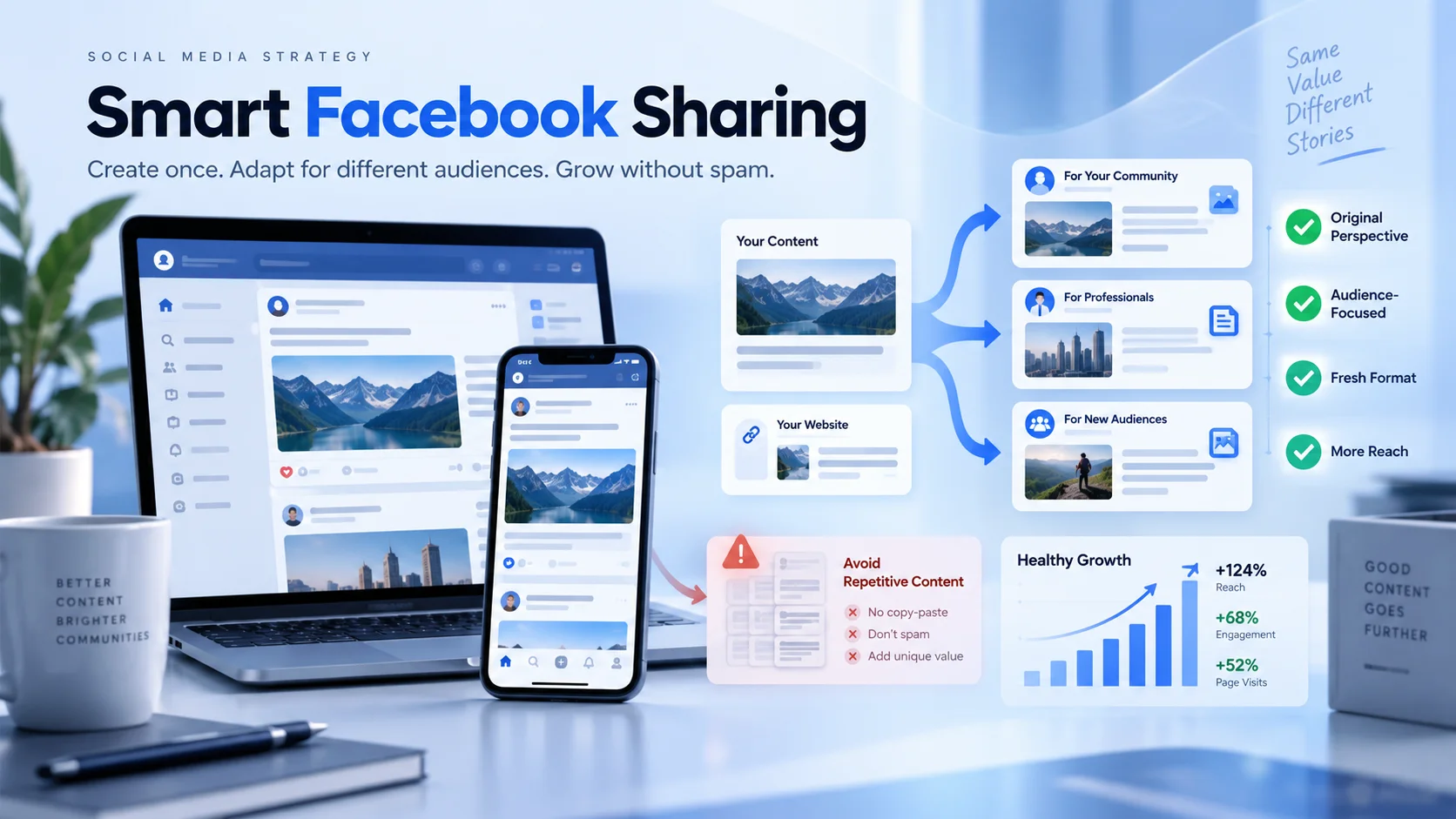
Facebook is no longer simply a chronological wall where every post automatically reaches the followers of a page.
Behind the Feed are complex systems for content ranking, automated spam detection, originality analysis, interaction quality assessment, and many other signals.
This means that two completely legitimate posts can receive very different levels of distribution depending on how, where, and when they are published.
During 2025 and 2026, Meta further strengthened its measures against content that appears mass-produced, repetitive, or primarily designed to manipulate distribution. The company has stated that accounts and pages flooding the Feed with spam or attempting to artificially increase reach may receive reduced distribution.
This raises an important question for every business:
How can we share the same piece of content across several Facebook destinations without making it look like spam?
One Piece of Content Does Not Mean One Post
Imagine that a company publishes a new article:
“How Software Is Transforming Sports Club Management”
We want that article to reach more people through:
But that is not necessarily the best approach.
From a technical perspective, a platform can recognize similarities between posts through multiple characteristics:
text + URL + image + timing + profile/page + behavior
Two posts do not necessarily have to be completely identical in order to be recognized as highly similar.
Facebook does not publish the exact formula or threshold at which content becomes classified as spam.
There is no publicly documented rule such as:
“Three identical posts within 20 minutes will trigger a restriction.”
That is why strategies based on discovering some imaginary numerical limit are fundamentally flawed.
A better approach is to make sure that every publication provides its own value.
Think of the Article as Source Content, Not as a Finished Social Media Post
One article should be treated as source content from which multiple posts can be created.
For example, the company Page could introduce the article like this:
The context around it is different.
More importantly, the reason for publishing each post is different.
Facebook Is Increasingly Prioritizing Original Content
Meta has continued to clarify its approach toward original content.
Content created directly by the author or Page is generally considered original, while duplicated material or content with only minimal changes can receive lower priority in distribution.
There is an important distinction here.
Repetitive content and unoriginal content are not exactly the same thing.
Unoriginal content usually refers to republishing someone else's material without providing meaningful additional value.
Repetitive or spam-like behavior can also involve your own content when the publishing pattern resembles automated or mass distribution.
Therefore, even if an article belongs entirely to your company, publishing it with exactly the same accompanying text across ten different places is not necessarily a good content distribution strategy.
Timing Is Also a Signal
Consider the following publishing pattern:
10:00 – Post published on the company Page
10:01 – Shared from a personal profile
10:02 – Published in a Facebook Group
10:03 – Published in a second Group
10:04 – Published in a third Group
10:05 – Published in a fourth Group
From a human perspective, this may simply look like a normal promotional campaign.
From the perspective of an automated anti-spam system, however, the pattern may look very different:
one URL → similar text → multiple destinations → extremely short time interval
We do not need to know Meta's exact internal formula to understand why such behavior can resemble automation.
A more natural approach is to distribute the content over time and adapt it to each audience.
There is no need to invent artificial intervals such as exactly 37 or 53 minutes.
There are no publicly documented “magic numbers.”
The main principle is simple:
The activity should resemble normal human communication, not a batch publishing script.
The Same URL Is Not Automatically the Problem
A common statement in social media marketing is:
“Facebook does not like external links.”
The reality is considerably more complicated.
The mere presence of a link to your own website does not automatically turn a post into spam.
The broader context matters much more:
URL + text + content + frequency + engagement + account history
It is perfectly normal for a company to regularly link to its own domain.
For example:
pleniko.com
can naturally appear in many different company posts.
A potential problem arises when dozens of posts look almost identical and their only purpose is to redirect people away from Facebook.
This is why the Facebook post itself should provide some value.
It should not merely be a container for a URL.
Should the Link Be Placed in the First Comment?
Another very common approach is:
“Link in the first comment.”
This is often described as a technique for “beating the algorithm.”
There is no public Meta rule guaranteeing that placing a link in the first comment will automatically increase reach.
Sometimes this format makes sense from a presentation perspective, but it should not become a mechanical rule applied to every post.
An even worse pattern would be publishing dozens of posts that all end with exactly the same sentence:
“Link in the first comment 👇👇👇”
followed immediately by the same type of URL in every comment section.
Once again, this creates a repetitive behavioral pattern.
The better question is not:
“Where can we hide the link?”
It is:
“Does this post provide enough value for someone to stop and read it?”
Hashtags: More Does Not Mean Better
A large number of hashtags does not automatically improve distribution.
Using too many unrelated hashtags can make the post look noisy, promotional, or artificially optimized.
For a business post:
#Software #RealEstate #Technology
can be considerably more meaningful than:
#software #business #technology #web #website #seo #marketing #facebook #facebookmarketing #success #viral #entrepreneur #startup #money #businessowner
A hashtag should describe the actual content.
It should not be used as a brute-force attempt to reach the algorithm.
Engagement Bait Is Not a Sustainable Strategy
Another common tactic is artificially encouraging interactions:
“Write YES if you agree!”
“Tag three friends!”
“LIKE + SHARE so everyone can see this!”
These techniques may generate interactions, but they do not necessarily generate meaningful engagement.
Facebook has worked against artificial engagement manipulation for years, and Meta has continued strengthening its systems against fake or coordinated engagement patterns.
A better question would be:
“How do you solve this problem in your organization?”
This creates an opportunity for genuine discussion.
And genuine discussion is significantly more useful than collecting meaningless comments containing only “YES.”
A Better Technical Workflow for Facebook Content
A healthy social media publishing workflow can look like this:
This distinction also matters.
Suppose a company Page publishes a new article and the owner wants to promote it through their personal profile.
There are two basic options.
The first is Facebook's standard Share function.
This clearly identifies the original publication and its source.
The second option is to create a completely new post with original commentary while linking to the same article.
This approach can make sense when the personal profile adds additional context, a personal experience, or a story behind the project.
Neither method should automatically be used every time.
The more useful question is:
“Does this new publication add something to the original post?”
If the answer is no, there may be little reason to publish an almost identical version again.
One Website, Many Facebook Posts
For a corporate website such as:
pleniko.com
it is completely normal for many Facebook posts to point to the same domain.
For example:
pleniko.com/blog/article-1
pleniko.com/blog/article-2
pleniko.com/services
pleniko.com/project/clubo360
This is natural behavior for a company Facebook Page.
Even the same specific URL can be published more than once when there is a legitimate reason.
An article may first be shared when it is published and then become relevant again several months later.
The second post, however, can use a different perspective.
First publication:
The content surrounding it has.
That is the important distinction.
The Best Facebook Optimization Is Actually Human Context
In SEO, we optimize a web page so search engines can understand and rank it properly.
On Facebook, many people make the mistake of trying to do exactly the same thing — optimizing every post primarily for the algorithm.
The problem is that Feed algorithms constantly evolve.
What remains sustainable is:
original content + relevant audience + natural context + genuine interaction
The goal should therefore not be:
“How do we trick Facebook into showing this post?”
A much better question is:
“How can every new share give someone a reason to read it?”
When a company begins thinking this way, its social media strategy becomes significantly more sustainable.
Conclusion
Facebook's anti-spam systems do not necessarily evaluate only the individual post.
They can also evaluate broader patterns of behavior.
Therefore, using the same website, sharing the same article, or repeatedly linking to your own company domain is not inherently a problem.
Problems can arise when the overall behavior begins to resemble automated mass distribution:
copy → paste → share → share → share
A healthier model is:
create → adapt → publish → interact → reuse with new context
This is better not only for the algorithm.
It is also better for the people reading the content.
And in the long term, that should be the primary goal of every good social media strategy.
Behind the Feed are complex systems for content ranking, automated spam detection, originality analysis, interaction quality assessment, and many other signals.
This means that two completely legitimate posts can receive very different levels of distribution depending on how, where, and when they are published.
During 2025 and 2026, Meta further strengthened its measures against content that appears mass-produced, repetitive, or primarily designed to manipulate distribution. The company has stated that accounts and pages flooding the Feed with spam or attempting to artificially increase reach may receive reduced distribution.
This raises an important question for every business:
How can we share the same piece of content across several Facebook destinations without making it look like spam?
One Piece of Content Does Not Mean One Post
Imagine that a company publishes a new article:
“How Software Is Transforming Sports Club Management”
We want that article to reach more people through:
- the company Facebook Page;
- the owner's personal profile;
- relevant Facebook Groups;
- partner or related Pages.
But that is not necessarily the best approach.
From a technical perspective, a platform can recognize similarities between posts through multiple characteristics:
text + URL + image + timing + profile/page + behavior
Two posts do not necessarily have to be completely identical in order to be recognized as highly similar.
Facebook does not publish the exact formula or threshold at which content becomes classified as spam.
There is no publicly documented rule such as:
“Three identical posts within 20 minutes will trigger a restriction.”
That is why strategies based on discovering some imaginary numerical limit are fundamentally flawed.
A better approach is to make sure that every publication provides its own value.
Think of the Article as Source Content, Not as a Finished Social Media Post
One article should be treated as source content from which multiple posts can be created.
For example, the company Page could introduce the article like this:
Digitalization is gradually changing how sports clubs manage training sessions, athletes, payments, and communication with parents. In our latest article, we explore some of the technologies behind these processes.The owner's personal profile could approach it from a completely different angle:
Over the past few months, we have been working on a sports club management platform, and one thing has become increasingly clear: many important processes are still handled through spreadsheets, messaging apps, and paper. I decided to write a little about the technical side of that problem.A relevant Facebook Group could receive a more discussion-oriented version:
A question for people managing sports clubs: how do you currently organize athlete records, payments, schedules, and communication with parents? While developing our own platform, we identified several recurring challenges and summarized some of them in this article.The URL can remain exactly the same.
The context around it is different.
More importantly, the reason for publishing each post is different.
Facebook Is Increasingly Prioritizing Original Content
Meta has continued to clarify its approach toward original content.
Content created directly by the author or Page is generally considered original, while duplicated material or content with only minimal changes can receive lower priority in distribution.
There is an important distinction here.
Repetitive content and unoriginal content are not exactly the same thing.
Unoriginal content usually refers to republishing someone else's material without providing meaningful additional value.
Repetitive or spam-like behavior can also involve your own content when the publishing pattern resembles automated or mass distribution.
Therefore, even if an article belongs entirely to your company, publishing it with exactly the same accompanying text across ten different places is not necessarily a good content distribution strategy.
Timing Is Also a Signal
Consider the following publishing pattern:
10:00 – Post published on the company Page
10:01 – Shared from a personal profile
10:02 – Published in a Facebook Group
10:03 – Published in a second Group
10:04 – Published in a third Group
10:05 – Published in a fourth Group
From a human perspective, this may simply look like a normal promotional campaign.
From the perspective of an automated anti-spam system, however, the pattern may look very different:
one URL → similar text → multiple destinations → extremely short time interval
We do not need to know Meta's exact internal formula to understand why such behavior can resemble automation.
A more natural approach is to distribute the content over time and adapt it to each audience.
There is no need to invent artificial intervals such as exactly 37 or 53 minutes.
There are no publicly documented “magic numbers.”
The main principle is simple:
The activity should resemble normal human communication, not a batch publishing script.
The Same URL Is Not Automatically the Problem
A common statement in social media marketing is:
“Facebook does not like external links.”
The reality is considerably more complicated.
The mere presence of a link to your own website does not automatically turn a post into spam.
The broader context matters much more:
URL + text + content + frequency + engagement + account history
It is perfectly normal for a company to regularly link to its own domain.
For example:
pleniko.com
can naturally appear in many different company posts.
A potential problem arises when dozens of posts look almost identical and their only purpose is to redirect people away from Facebook.
This is why the Facebook post itself should provide some value.
It should not merely be a container for a URL.
Should the Link Be Placed in the First Comment?
Another very common approach is:
“Link in the first comment.”
This is often described as a technique for “beating the algorithm.”
There is no public Meta rule guaranteeing that placing a link in the first comment will automatically increase reach.
Sometimes this format makes sense from a presentation perspective, but it should not become a mechanical rule applied to every post.
An even worse pattern would be publishing dozens of posts that all end with exactly the same sentence:
“Link in the first comment 👇👇👇”
followed immediately by the same type of URL in every comment section.
Once again, this creates a repetitive behavioral pattern.
The better question is not:
“Where can we hide the link?”
It is:
“Does this post provide enough value for someone to stop and read it?”
Hashtags: More Does Not Mean Better
A large number of hashtags does not automatically improve distribution.
Using too many unrelated hashtags can make the post look noisy, promotional, or artificially optimized.
For a business post:
#Software #RealEstate #Technology
can be considerably more meaningful than:
#software #business #technology #web #website #seo #marketing #facebook #facebookmarketing #success #viral #entrepreneur #startup #money #businessowner
A hashtag should describe the actual content.
It should not be used as a brute-force attempt to reach the algorithm.
Engagement Bait Is Not a Sustainable Strategy
Another common tactic is artificially encouraging interactions:
“Write YES if you agree!”
“Tag three friends!”
“LIKE + SHARE so everyone can see this!”
These techniques may generate interactions, but they do not necessarily generate meaningful engagement.
Facebook has worked against artificial engagement manipulation for years, and Meta has continued strengthening its systems against fake or coordinated engagement patterns.
A better question would be:
“How do you solve this problem in your organization?”
This creates an opportunity for genuine discussion.
And genuine discussion is significantly more useful than collecting meaningless comments containing only “YES.”
A Better Technical Workflow for Facebook Content
A healthy social media publishing workflow can look like this:
- Create one original source asset
An article, video, case study, analysis, product announcement, or company update. - Identify the different audiences
Company followers, personal connections, customers, professional communities, partners, and relevant Facebook Groups. - Create different copy for each audience
Avoid copying and pasting exactly the same post everywhere. - Change the hook
Use a corporate, personal, technical, educational, or discussion-oriented angle depending on the audience. - Use different visuals where appropriate
The same article does not always need to be represented by exactly the same image. - Do not publish everything at once
Allow content distribution to happen naturally over time. - Avoid excessive hashtags, emojis, and aggressive calls to action
- Do not publish in unrelated Groups simply to generate additional reach
- Add unique value every time the content is shared
- Monitor Account Status and Professional Dashboard
When Facebook provides information about distribution or policy issues, review it before assuming that the problem is caused by the content itself.
This distinction also matters.
Suppose a company Page publishes a new article and the owner wants to promote it through their personal profile.
There are two basic options.
The first is Facebook's standard Share function.
This clearly identifies the original publication and its source.
The second option is to create a completely new post with original commentary while linking to the same article.
This approach can make sense when the personal profile adds additional context, a personal experience, or a story behind the project.
Neither method should automatically be used every time.
The more useful question is:
“Does this new publication add something to the original post?”
If the answer is no, there may be little reason to publish an almost identical version again.
One Website, Many Facebook Posts
For a corporate website such as:
pleniko.com
it is completely normal for many Facebook posts to point to the same domain.
For example:
pleniko.com/blog/article-1
pleniko.com/blog/article-2
pleniko.com/services
pleniko.com/project/clubo360
This is natural behavior for a company Facebook Page.
Even the same specific URL can be published more than once when there is a legitimate reason.
An article may first be shared when it is published and then become relevant again several months later.
The second post, however, can use a different perspective.
First publication:
We have published a new analysis about…Several months later:
A few months ago, we looked at this problem in detail. Since then, we have implemented some of the ideas discussed in the article, and the results have been interesting…The URL has not changed.
The content surrounding it has.
That is the important distinction.
The Best Facebook Optimization Is Actually Human Context
In SEO, we optimize a web page so search engines can understand and rank it properly.
On Facebook, many people make the mistake of trying to do exactly the same thing — optimizing every post primarily for the algorithm.
The problem is that Feed algorithms constantly evolve.
What remains sustainable is:
original content + relevant audience + natural context + genuine interaction
The goal should therefore not be:
“How do we trick Facebook into showing this post?”
A much better question is:
“How can every new share give someone a reason to read it?”
When a company begins thinking this way, its social media strategy becomes significantly more sustainable.
Conclusion
Facebook's anti-spam systems do not necessarily evaluate only the individual post.
They can also evaluate broader patterns of behavior.
Therefore, using the same website, sharing the same article, or repeatedly linking to your own company domain is not inherently a problem.
Problems can arise when the overall behavior begins to resemble automated mass distribution:
copy → paste → share → share → share
A healthier model is:
create → adapt → publish → interact → reuse with new context
This is better not only for the algorithm.
It is also better for the people reading the content.
And in the long term, that should be the primary goal of every good social media strategy.