

Pleniko Blog
Football Club Management Software: Why a Great Website Needs a Powerful System Behind It
- Software
- Football
- Sports Clubs
- Management
- Digital Transformation
 AuthorPlamen Nikolov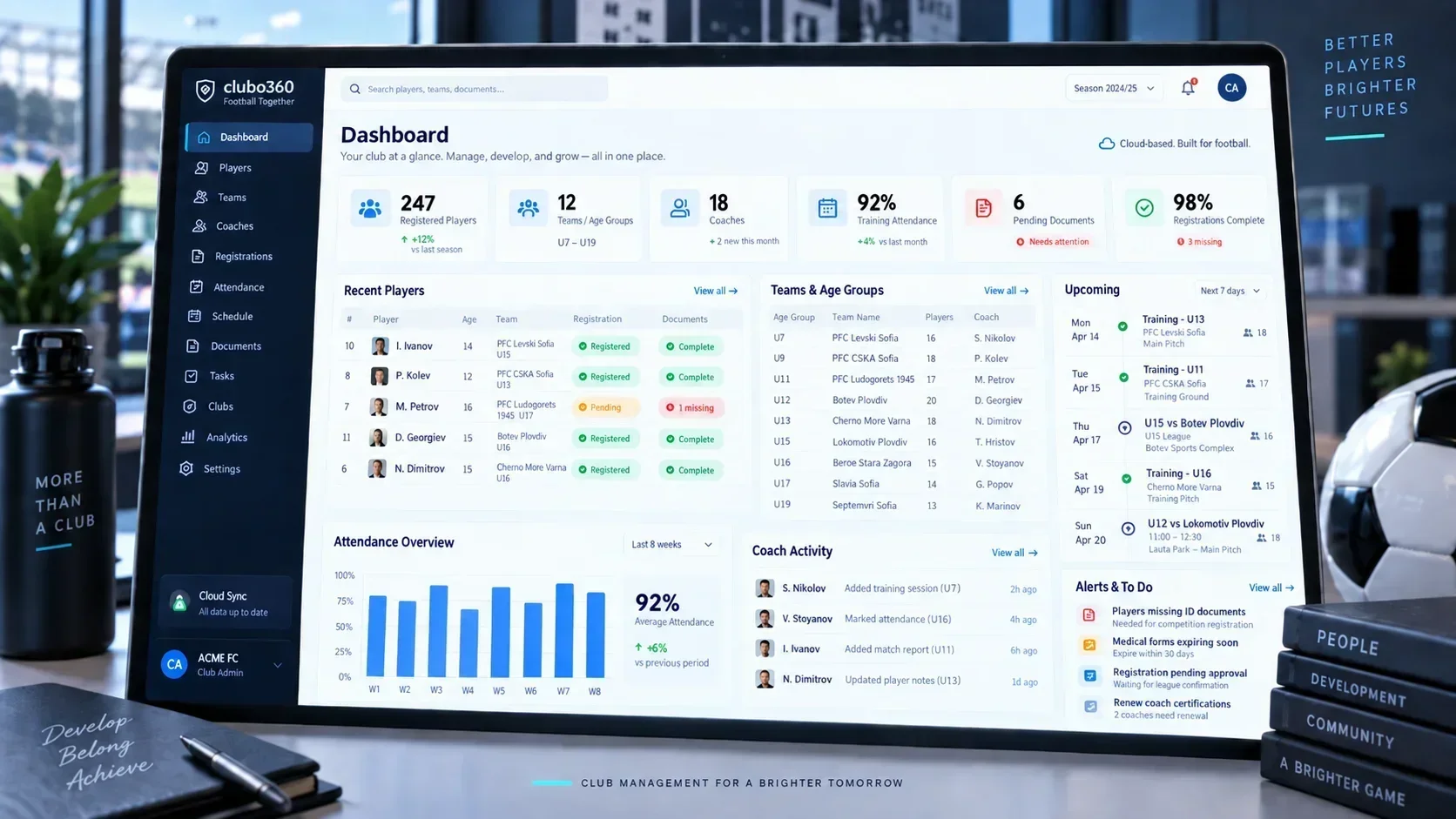
A great football club website starts with the system behind it
When people think about a football club website, they usually think about news, team photos, coaches, fixtures, results and information about the club.
But that is only the public-facing layer.
For a football club to be truly well organized, its website needs something much more powerful behind it: a football club management system that connects players, coaches, teams, registrations and day-to-day administration in one centralized environment.
The difference between a normal website and a complete digital football platform is simple:
the website presents the club, while the system behind it helps run the club.
Why does a football club need dedicated management software?
Even a relatively small football academy generates a significant amount of information.
Every season, the club needs to manage:
The problem appears when the organization begins to grow.
One spreadsheet becomes five.
One administrator has one version while a coach has another.
Coaches keep their own player records, while the club office maintains a separate list.
Eventually, the organization has a large amount of information but no single place containing the current and reliable version of that information.
This is one of the main problems that good football club management software should solve.
One source of information
One of the most important principles of a good club management system is simple: information should be entered once.
When a player moves from one age group to another, the change should not need to be repeated across multiple spreadsheets and then manually updated on the public website.
When a new coach joins the club, their information should not be entered into several unrelated systems.
When a new team is created, its squad should not need to be maintained independently by multiple people.
A properly designed system centralizes this information and allows different parts of the platform to use the same data where appropriate.
This reduces duplicated work, human error and unnecessary administration.
A digital profile for every player
When people think about a football club website, they usually think about news, team photos, coaches, fixtures, results and information about the club.
But that is only the public-facing layer.
For a football club to be truly well organized, its website needs something much more powerful behind it: a football club management system that connects players, coaches, teams, registrations and day-to-day administration in one centralized environment.
The difference between a normal website and a complete digital football platform is simple:
the website presents the club, while the system behind it helps run the club.
Why does a football club need dedicated management software?
Even a relatively small football academy generates a significant amount of information.
Every season, the club needs to manage:
- players;
- age groups;
- teams;
- coaches;
- training groups;
- player registrations;
- documents;
- training attendance;
- match participation;
- coaching observations;
- administrative notes;
- disciplinary records;
- parent information;
- club events;
- schedules.
The problem appears when the organization begins to grow.
One spreadsheet becomes five.
One administrator has one version while a coach has another.
Coaches keep their own player records, while the club office maintains a separate list.
Eventually, the organization has a large amount of information but no single place containing the current and reliable version of that information.
This is one of the main problems that good football club management software should solve.
One source of information
One of the most important principles of a good club management system is simple: information should be entered once.
When a player moves from one age group to another, the change should not need to be repeated across multiple spreadsheets and then manually updated on the public website.
When a new coach joins the club, their information should not be entered into several unrelated systems.
When a new team is created, its squad should not need to be maintained independently by multiple people.
A properly designed system centralizes this information and allows different parts of the platform to use the same data where appropriate.
This reduces duplicated work, human error and unnecessary administration.
A digital profile for every player
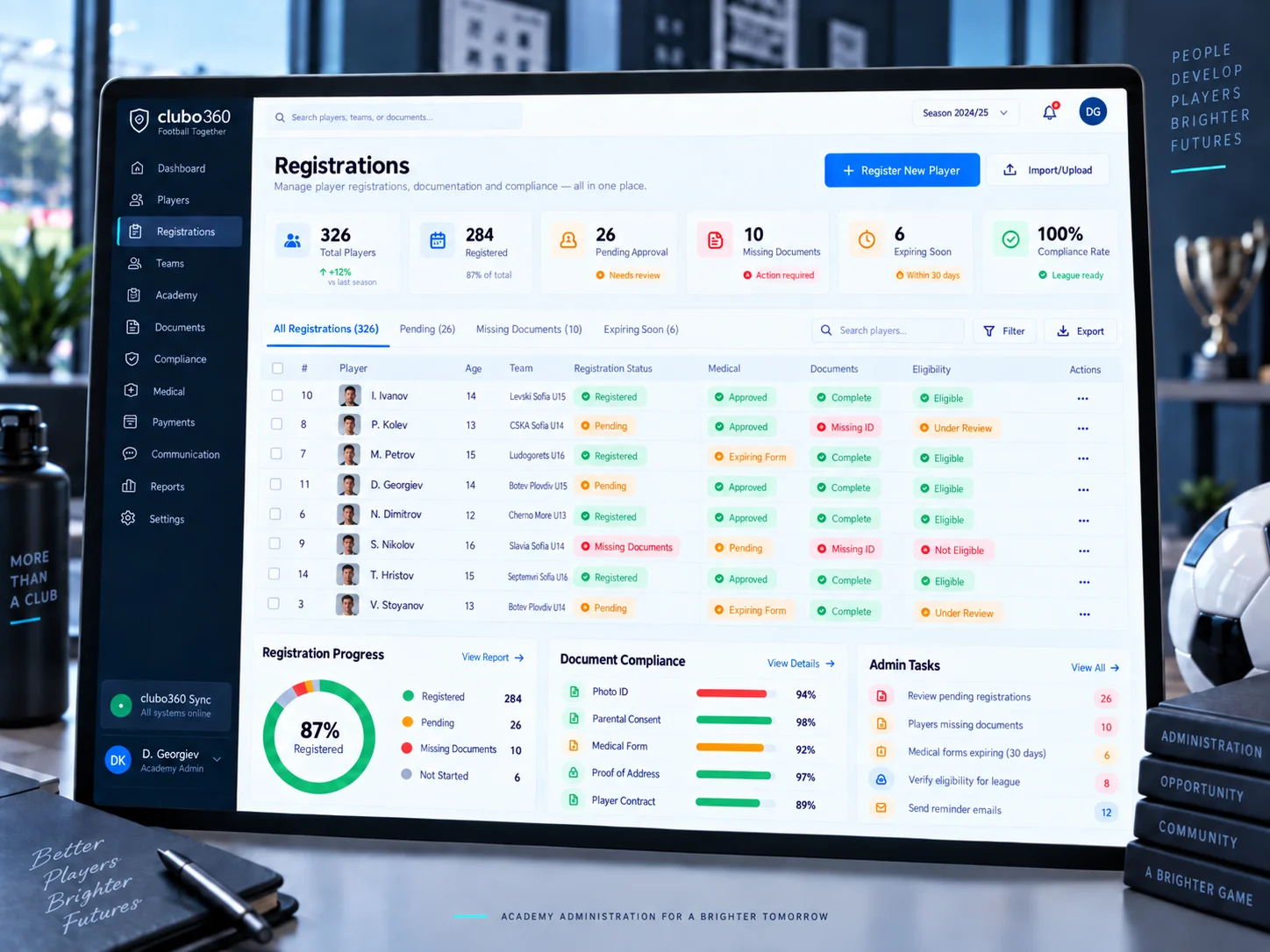
One of the most valuable parts of modern football academy management software is the ability to maintain a structured digital profile for every player.
A football player is much more than a name, photograph and shirt number.
Over time, the club builds a history around that player:
- when they joined the club;
- which teams they played for;
- which coaches worked with them;
- their playing position;
- their registration status;
- available and missing documents;
- training attendance;
- match participation;
- coaching observations;
- administrative notes;
- disciplinary records;
- progression through different age groups.
A child may spend five, eight or even more years within the same academy.
During that time, they may play in several age groups and work with multiple coaches.
If information starts from zero every season, the club gradually loses its own history.
A good player management system preserves it.
Player registration should not become administrative chaos
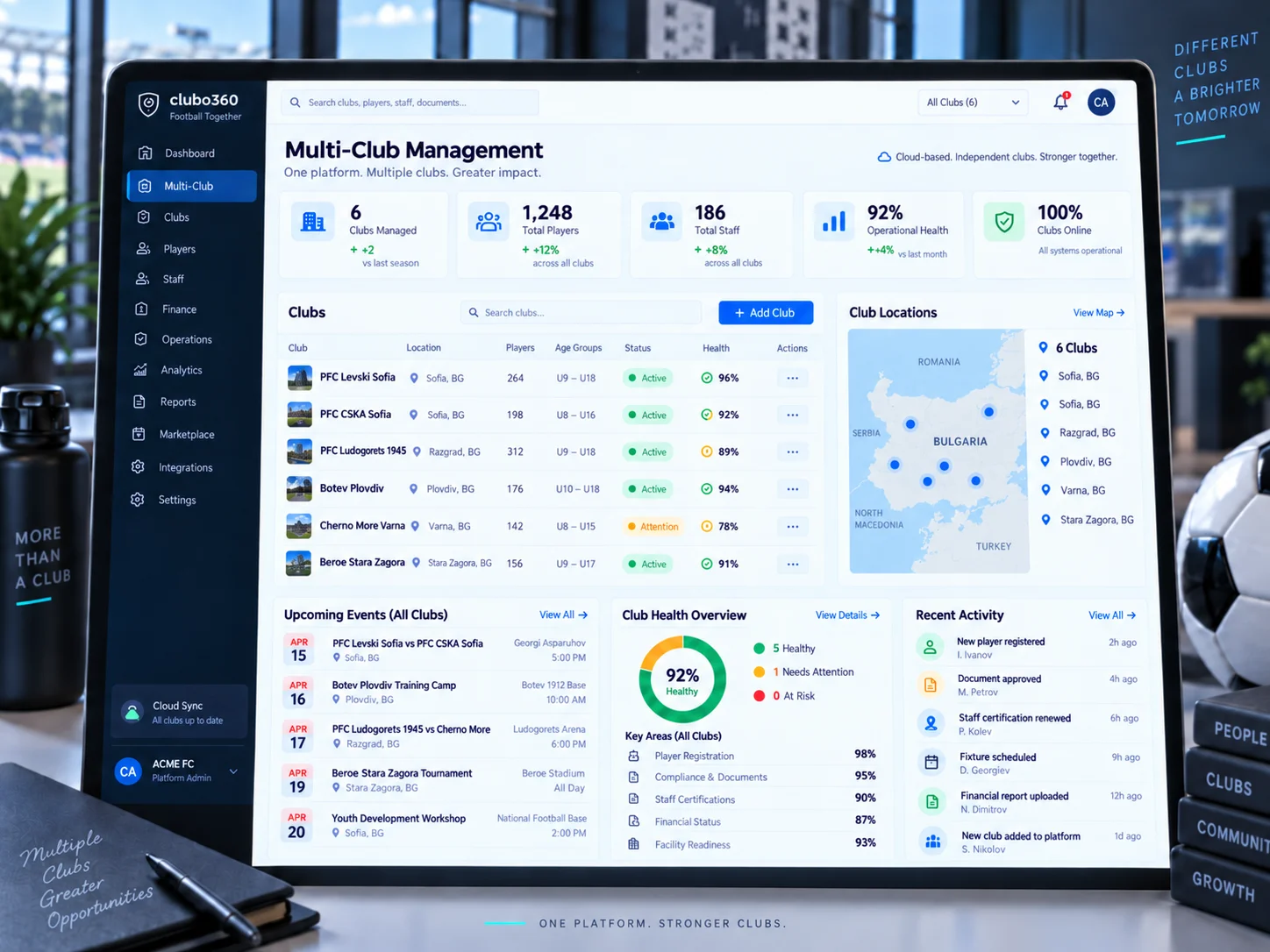
Player registration is one of the processes that requires constant administrative attention.
At any moment, the club should be able to answer questions such as:
Which players are registered?
Which players are still waiting for registration?
Which documents are missing?
Which team is a specific player registered with?
Are there incomplete records?
What is the current status of a particular player?
The answers should not require searching through folders, emails and multiple spreadsheets.
A good football player registration system should make the current status immediately visible and direct administrative attention toward the players who actually require action.
The purpose of the software is not to replace the administrator.
It is to allow the administrator to work faster and with better information.
Managing teams and age groups
Every football club has its own organizational structure.
A club may include:
- a senior team;
- youth squads;
- children's teams;
- development groups;
- training groups;
- players temporarily training with another squad.
The system should make it easy to understand:
which player belongs to which team;
who coaches the team;
which players recently moved;
who progressed to an older age group;
who recently joined the club;
who is no longer active.
This gives the organization a clear and traceable structure.
Coaches should manage players, not spreadsheets
A good system must work well for coaches as well as administrators.
A coach does not need access to every administrative function within the club.
They need fast and simple access to the information relevant to their own team.
This can include:
- squad lists;
- training attendance;
- individual player notes;
- observations;
- disciplinary notes;
- player history;
- upcoming training sessions or matches.
This is an important principle.
The best football management software is not necessarily the system with the largest number of features.
It is the system that people can actually use every day without unnecessary complexity.
Different users need different access
A football club includes people with very different responsibilities.
Club management has one set of needs.
Administrators have another.
Coaches have different responsibilities again.
Parents and players require a completely different view.
A modern sports club management system should therefore provide access based on the role of each user.
An administrator may manage club structure and documents.
A coach may work with their own teams.
Club management may have an overview of the entire organization.
A parent may only access information related to their own child.
A player may have access to their personal profile and information intended for them.
This improves usability, organization and information control.
The public website and club administration should work together
A football club website should not exist as a completely separate system that needs to be updated manually.
If information already exists within the club management platform, there is usually no reason to enter it again.
When a new team is created, the approved public information can be used by the website.
When a new coach joins, the public coach profile can be linked to the same central information.
When a player changes age groups, the relevant public squad information can be updated using the centralized system.
Naturally, internal information and public information must remain clearly separated.
But when both sides use the same underlying structure, the club avoids unnecessary duplication.
Cloud-based management follows the club wherever it goes
A football club does not operate from a single desk.
A coach may be at the training ground.
An administrator may be in the club office.
A director may be attending an away match.
Another coach may be at a tournament.
This is why modern cloud-based sports club management is so useful.
Authorized users should be able to access the information they need without depending on one specific office computer.
There should not be a situation where someone says:
“the latest spreadsheet is on the computer at the office.”
There should be one current version of the information.
That allows the club to operate efficiently across different locations and devices.
The history of a football club is a valuable digital asset
A good management platform should not only focus on the current season.
After five years, a football club may have worked with hundreds or thousands of players.
Without a centralized system, much of that history is eventually lost.
With a structured platform, the organization can maintain records of:
- former players;
- previous squads;
- coaching periods;
- player movement between age groups;
- player development;
- historical club structure.
One platform can support multiple football clubs
A well-designed system does not necessarily need to be limited to a single football academy.
One platform can support multiple independent clubs.
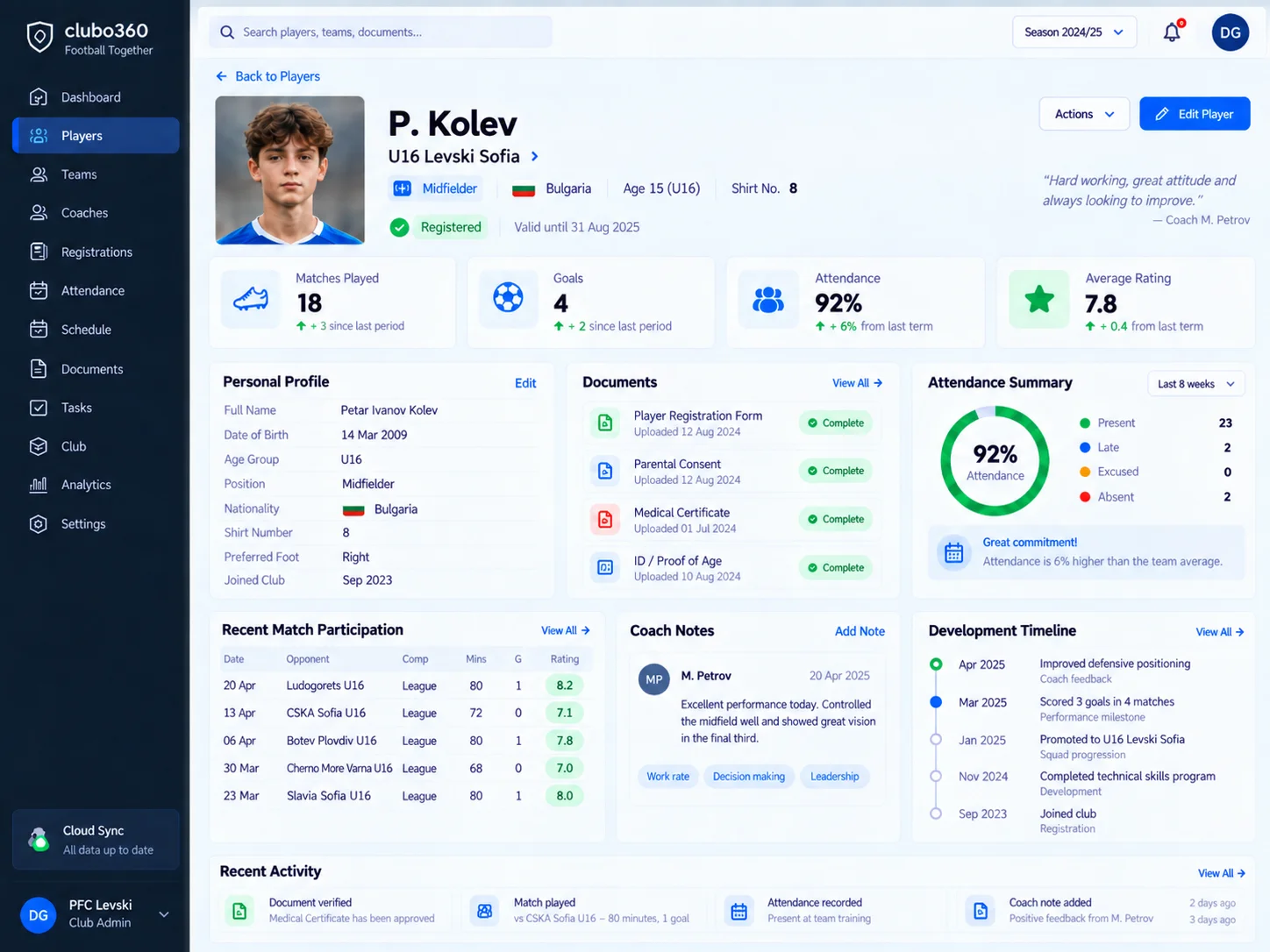
Each club can have:
- its own administrators;
- its own players;
- its own coaches;
- its own teams;
- its own public website;
- its own identity;
- its own data.
This makes it possible to onboard additional clubs without rebuilding the complete software product every time.
Automation gives time back to football
Football club administration includes many repetitive tasks.
Checking lists.
Monitoring registration statuses.
Finding missing documents.
Updating squads.
Reviewing player information.
Preparing reports.
With a properly designed system, many of these processes can be simplified or automated.
Instead of checking 400 players individually, an administrator can immediately see the 15 players requiring attention.
Instead of coaches maintaining separate lists, relevant information can already be part of the team profile.
Instead of updating the same information in several places, it can be managed centrally.
Technology stays in the background, while staff can focus their time on running the club and developing players.
The administration interface matters as much as the public website
A professional public website is important.
It represents the club to parents, players, partners, supporters and potential new members.
But the internal administration interface is used far more frequently.
A website visitor may spend five minutes browsing the club website.
A coach or administrator may use the management system every day for years.
That is why the internal interface must be:
- clear;
- fast;
- logical;
- easy to learn;
- accessible from different devices;
- organized around the club's real daily workflow.
Professional software makes complex processes feel simple.
The software must grow with the club
A football academy may start with 70 children.
A few seasons later, it may have 300.
The club may open additional training locations.
New age groups may be introduced.
More coaches may join.
New administrative processes may become necessary.
A good system should not be designed only for the size of the club today.
It should be able to grow together with the organization.
That is the difference between a temporary tool and real digital infrastructure.
The football club website is only the visible part
The public website remains extremely important.
It should represent the organization professionally and be fast, clear and easy to use.
But the real digital transformation happens behind it.
It happens where the club manages:
players;
teams;
coaches;
registrations;
documents;
administration;
club history.
When these elements work together as one connected system, the website stops being only an online brochure.
It becomes the public interface of the club's complete digital infrastructure.
Conclusion
A modern football club needs more than a good website.
It needs football club management software that creates structure around daily operations and allows the organization to grow without creating administrative chaos.
A strong platform connects players, coaches, teams, registrations, documentation, club history and the public website.
Information is entered once.
The right people can access it.
It appears where it is needed.
Historical information is preserved.
Administration becomes easier.
Because a great football club website does not begin with the homepage.
It begins with the system behind it.